Section 1.5 Language Variation
In Section 1.1 we introduced the idea of studying individual human langugaes in order to discover general principles that underlie human language as such. As examples of such individual human languages, we mentioned English, French, Polish, Turkish, Arabic and Vietnamese.
But what do we study when we study “a language” such as English? After all, there are many different versions of English (linguists call these versions varieties): there are different dialects (varieties spoken in particular places) and different sociolects (varieties spoken by particular social groups in particular places). Some of these dialects and sociolects are regarded (by a particular speech community as a whole, or by particular actors in the community, such as government or the educational system), to be standard languages (a standard is, roughly, what people will say is the “right” way to use the language). Some of the dialects are more similar to each other, some are more different — some are so different, that we may ask ourselves whether they still belong to the same language at all.
In linguistics, studying “a language” can mean studying this variation itself, recording how dialects and sociolects differ. These differences can be in pronunciation — for example, in most American English varieties, the “R” sound can occur after a vowel, in most British varieties it cannot. They can be differences in the lexicon — for example, a large vehicle built for transporting goods is referred to as a “lorry” in British English and as a “truck” in American English. And they can be grammatical — for example, British speakers often use plural verb forms with singular nouns referring to groups (The police were arresting the activists), American speakers do not ((The police was arresting the activists).
But studying “a language” can also mean studying a particular variety in detail. In practice, this often means studying one of the “standard” varieties — not because these varieties are special or particularly well-suited to tell us how human languages work, but because linguists tend to have a high degree of formal education and are likely to use one of these “standard” varieties themselves, and because there tends to be a large amount of textual data available for those “standard” varieties.
In this textbook, we will follow this practice, because we assume that the “standard” varieties are what students will be most familiar with (unless otherwise stated, Examples are often from — or typical for — American English). However, before we do so, let us take a brief look at Englishes around the world.
Subsection 1.5.1 English around the World
The world’s languages differ in their number of speakers and their geographical spread. Consider two extremes in Europe. One of the smallest languages, Votic (a Finnic language) is spoken as a frist language by only 21 people living in just two municipalities in in Russia near the Estonian border. In contrast, one of the largest languages, German (a Germanic language) is spoken as a first language by almost 90 Million speakers living in more than 12 000 municipalities spread across six countries (Germany, Austria, Switzerland, Belgium, Luxembourg and Liechtenstein).
Due to this vast difference in geographical extension, we would expect there to be more different dialects of German than of Votic. We would also expect there to be more different sociolects, as there are going to be more social and cultural differences in a speech community of 85 Million than in a speech community of twenty-one people.
If we zoom out and look at the whole world, there are many languages that are much larger in terms of their first-language speakers: Mandarin Chinese (a Sinitic language) has almost one billion, Spanish (a Romance language) has almost 500 Million, and English comes in third with around 372 Million speakers. All three languages can be expected to show a substantial amount of variation. Spanish and English are particularly interesting in this respect, because, like German, they are spoken in more than one country — Spanish is spoken in 20 countries (most of them in South America), and English is the most wide-spread language of all: it a de jure official language in 53 countries and 22 territories, and the de facto official language in four countries and seven territories.
De jure means ‘by law’, meaning that the role of English as an official language is set down in a country’s constitution or a similarly wide-reaching law, de facto means ‘by fact’, meaning that it is simply assumed to be the offical language in a country, used as a matter of course in law, education, government, the media and much of everday life. Interestingly, the two countries that we associate most closely with English — Great Britain and the United States of America — do not have English as a de jure official language (Donald Trump signed an executive order in March 2025 declaring it to be so, but only the U.S. Congress can decide on this issue, but it has never done so, and the U.S. constitution is silent on the matter).
What makes the situation of English even more complex than that of Spanish is that it also serves as a lingua franca — as a means of communication among speakers that do not share a common first language — at a massive scale. It is used as a working language for purposes such as education, administration, etc. in many countries where it is not an official language, and in many international organizations, such as the United Nations or the European Union. It has over one billion second-language speakers — speakers who did not acquire it as a first language as children, but who learned it in school or other educational insitutions or acquired it later in life. This makes it the most widely spoken second language by far (the next most widely-spoken one, Arabic, only has a third as many speakers).
Figure 1.5.1 shows the status of English around the world: Countries where English is a de-jure official language are shown in dark green (black in the b/w version) if it is also the dominant language, and in light green (black hatched) if it is not the dominant language, countries where it is a de-facto official language are shown in dark blue (dark grey) where it is dominant and light blue (grey hatched) where it is not, and countries where it is a working language are shown in yellow (black dots on white in the b/w version).
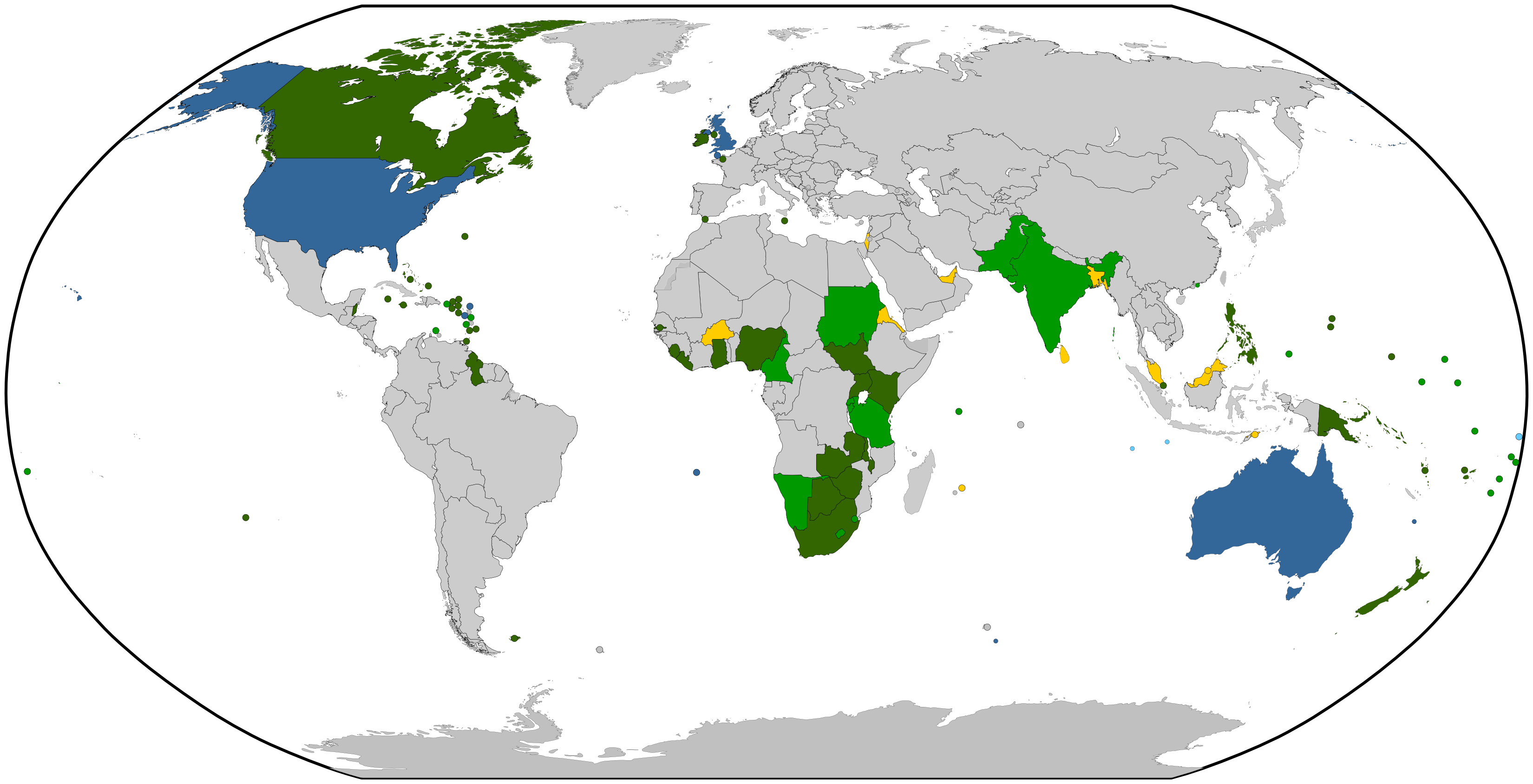
A map of the world showing the status of English around the world. It is de-jure official and the dominant language in the Bahamas, Barbados, Belize, Botswana, Canada, Fiji, The Gambia, Ghana, Grenada, Guyana, Ireland, Jamaica, Kenya, Liberia, Malawi, Malta, Micronesia, New Zealand, Nigeria, Papua New Guinea, Philippines, Saint Kitts and Nevis, Saint Vincent and the Grenadines, Sierra Leone, Singapore, Solomon Islands, South Africa, South Sudan, Trinidad and Tobago, Uganda, Vanuatu, Zambia, Zimbabwe, Anguilla, Bermuda, Cayman Islands, Falkland Islands, South Georgia, Gibraltar, Guam, Isle of Man, Jersey, Norfolk Island, Northern Mariana Islands, Pitcairn Islands, Sint Maarten, Turks and Caicos Islands, United States Virgin Islands, and the Virgin Islands (British); it is de-jure official but non-dominant in Akrotiri and Dhekelia, American Samoa, the Cook Islands, Curaçao, Hong Kong, Niue, Puerto Rico, Burundi, Cameroon, Dominica, Eswatini, India, Kiribati, Lesotho, the Marshall Islands, Namibia, Nauru, Pakistan, Palau, Rwanda, Saint Lucia, Samoa, Seychelles, Sudan, Tanzania, Tonga, and Tuvalu; it is de-facti official and dominant in Antigua and Barbuda, Australia, British Indian Ocean Territory, Guernsey, Montserrat, Saint Helena, Ascension and Tristan da Cunha, the United Kingdom, the United States of America; it is de-facto official but not dominant in the Christmas Island, the Cocos (Keeling) Islands, and Tokelau; and it is a working language in Bangladesh, Brunei, Burkina Faso, Eritrea, Israel, Malaysia, Mauritius, Sri Lanka, Timor-Leste, and the United Arab Emirates.
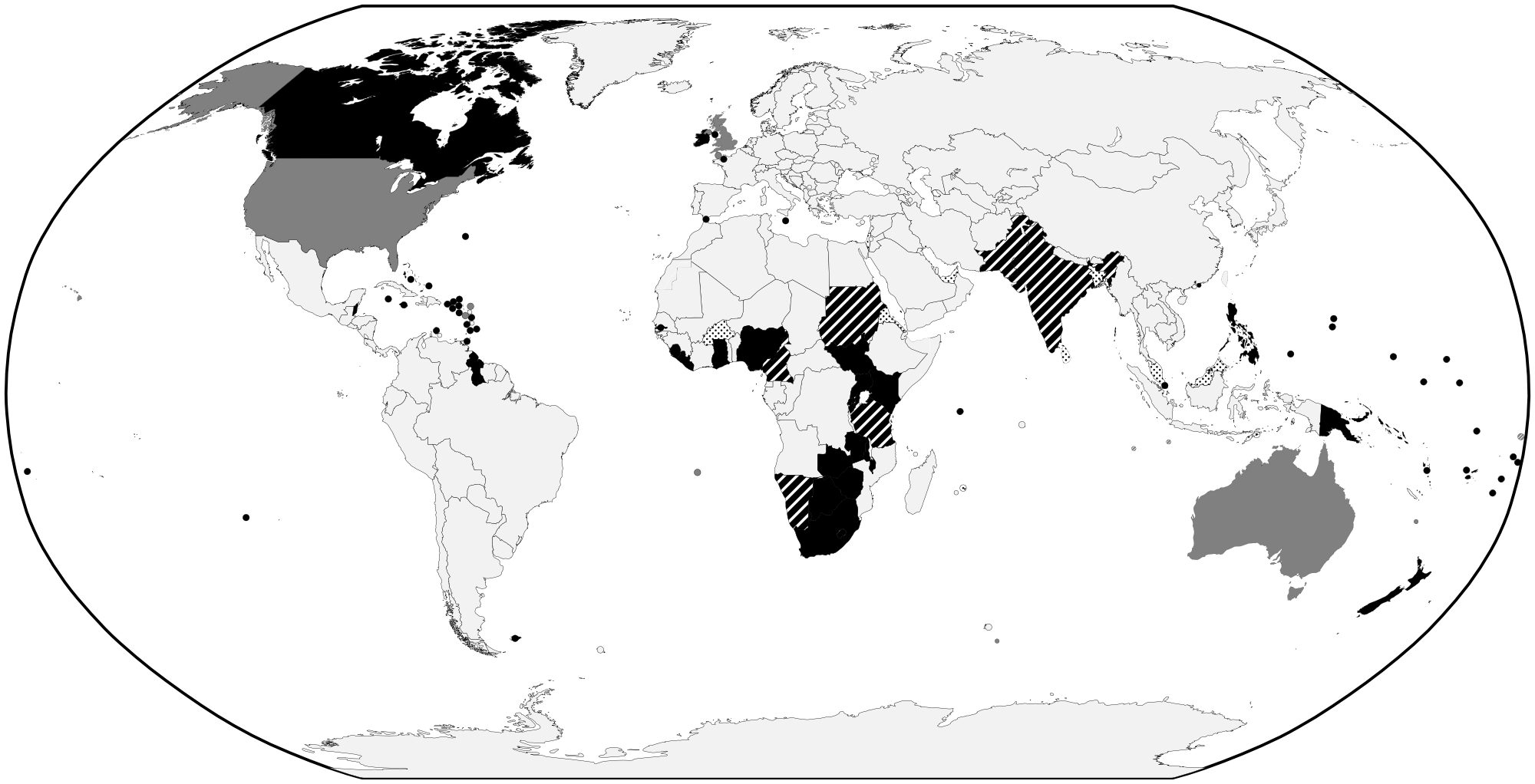
A map of the world showing the status of English around the world. It is de-jure official and the dominant language in the Bahamas, Barbados, Belize, Botswana, Canada, Fiji, The Gambia, Ghana, Grenada, Guyana, Ireland, Jamaica, Kenya, Liberia, Malawi, Malta, Micronesia, New Zealand, Nigeria, Papua New Guinea, Philippines, Saint Kitts and Nevis, Saint Vincent and the Grenadines, Sierra Leone, Singapore, Solomon Islands, South Africa, South Sudan, Trinidad and Tobago, Uganda, Vanuatu, Zambia, Zimbabwe, Anguilla, Bermuda, Cayman Islands, Falkland Islands, South Georgia, Gibraltar, Guam, Isle of Man, Jersey, Norfolk Island, Northern Mariana Islands, Pitcairn Islands, Sint Maarten, Turks and Caicos Islands, United States Virgin Islands, and the Virgin Islands (British); it is de-jure official but non-dominant in Akrotiri and Dhekelia, American Samoa, the Cook Islands, Curaçao, Hong Kong, Niue, Puerto Rico, Burundi, Cameroon, Dominica, Eswatini, India, Kiribati, Lesotho, the Marshall Islands, Namibia, Nauru, Pakistan, Palau, Rwanda, Saint Lucia, Samoa, Seychelles, Sudan, Tanzania, Tonga, and Tuvalu; it is de-facti official and dominant in Antigua and Barbuda, Australia, British Indian Ocean Territory, Guernsey, Montserrat, Saint Helena, Ascension and Tristan da Cunha, the United Kingdom, the United States of America; it is de-facto official but not dominant in the Christmas Island, the Cocos (Keeling) Islands, and Tokelau; and it is a working language in Bangladesh, Brunei, Burkina Faso, Eritrea, Israel, Malaysia, Mauritius, Sri Lanka, Timor-Leste, and the United Arab Emirates.
No other language in the history of humankind has ever had such a wide geographic spread, such a large number of first-language speech communities, and such a vast number of second-language speakers. Thus, it is an interesting question what consequences this situation has for variation and change in English. The one language in our history that came close was Latin, spoken in the Western part of the Roman empire, and it famously split into what we now call the Romance languages — Italian, French, Spanish, Portuguese, and Romanian and many smaller ones such as Galician, Catalan, Occitan, Romansh, etc.). Languages whose shared ancestry we can still perceive but that are in most cases not mutually intelligible.
It is sometimes speculated whether the same thing will happen to English, but there is a crucial difference between the days of the Roman Empire and our time: communication technologies. When the Roman Empire collapsed, speakers no longer communicated across regions, there were no mass media, there was no shared linguistic context any longer. This is different to-day (it was different even one or two hundred years ago) — communication across regions has never stopped since English began its spread around the world. This may change in the future, and if it does, English will eventually break apart just like Latin did.
But for now, this is not happening. English is one language, even though it varies substantially across different speech communities in terms of pronunciation, lexicon and grammar.
Subsection 1.5.2 Two models of World English
There are two well-known models of relationship between different varieties of English around the world. Both could be criticized in many ways, but they have been useful in thinking about and discussing the role and nature of English.
The first of these models is typically referred to as the “Three Concentric Circles of English”, developed by the Indian linguist Braj Kachru in the early 1980s. It is shown in Figure 1.5.3 (as you can see, it shows ovals instead of circles and the ovals are not concentric, but this is how Kachru represented his model).
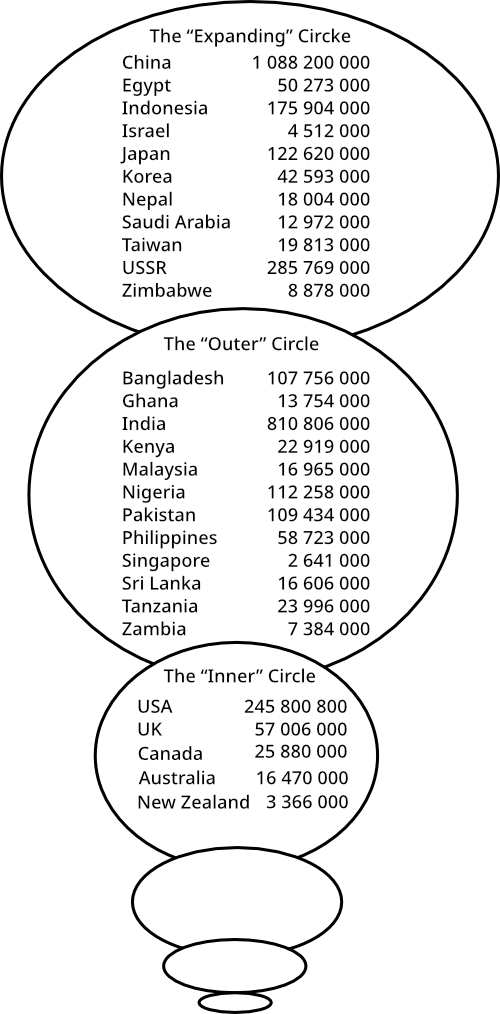
A series of six overlapping ovals stacked vertically and increasing in size from bottom to top. The bottom three ovals are empty, the fourth oval from the bottom is labelled "The ’Inner’ Circle" and lists the following countries and their population: USA (245,800,000), UK (57,006,000), Canada (25,880,000), Australia (16,470,000), and New Zealand (3,366,000). The fifth oval from the bottom (second from the top) is labelled "The ’Expanding’ Circle" and lists the following countries and their population: Bangladesh (107,756,000), Ghana (13,754,000), India (810,806,000), Kenya (22,919,000), Malaysia (16,965,000), Nigeria (112,258,000), Pakistan (109,434,000), Philippines (58,723,000), Singapore (2,641,000), Sri Lanka (16,606,000), Tanzania (23,996,000), and Zambia (7,384,000). The top oval is labelled "The ’Expanding’ Circle" and lists the following countries and their population: China (1,088,200,000), Egypt (50,273,000), Indonesia (175,904,000), Israel (4,512,000), Japan (122,620,000), Korea (42,593,000), Nepal (18,004,000), Saudi Arabia (12,972,000), Taiwan (19,813,000), USSR (285,796,000), and Zimbabwe (8,878,000).
The bottom three circles are supposed to represent the early history of English that is not relevant to the model. The “Inner” Circle represents what Kachru calls the “first diaspora” of English — its spread, through settler colonialism and penal colonialism, from Britain to the USA and Canada and to Australia and New Zealand, where English is now the dominant language among the descendants of the colonists and of people who have migrated to these countries since. The “Outer” Circle represents what Kachru calls the “second diaspora” of English — its spread through exploitation colinialism and trade colonialism to Africa and South Asia, where English is spoken alongside other languages by the descendants of the colonized people. The “Expanding Circle” represents the use of English as a working language in non-English speaking countries (its function as a lingua franca). Note that English-based creoles that emerged mainly in the context of plantation colonialism, are left out of the model because Kachru (rightly) sees their linguistic relationship to English as too complex to be included; in terms of their history, they would belong in the Outer circle.
Kachru was interested in the relationship between varieties in the different circles in terms of dimensions such as language norms and linguistic identities. The Inner Circle varieties constitute established norms of English and are an integral part of their speakers’ cultural identities. None of the varieties serve as a norm for the others, they are all felt to be autonomous by their speech communities. This makes English a pluricentric language, i.e., one that has more than one standard variety. These varieties are potentially “norm-providing” — English speech communities in the other circles may orient themselves towards these varieties when looking for language standards.
The Outer Circle varieties were assumed by Kachru do be “norm-developing”. While they may still look at the Inner Circle varieties as a standard, they are in the process of becoming independent. They are influenced in various ways by other languages spoken by their speech communities, making them in many cases more visibly different from the Inner Circle varieties than the Inner Circle varieties are to each other, and they contribute to the cultural identities of their speech communities only in conjunction with, or contrast to, these other languages.
The Expanding Circle varieties are norm-dependent in Kachru’s view. Since they are spoken exclusively as a foreign language, their speakers always look to one or more of the Inner Circle varieties for guidance as to how they are to be used — for example, many school curricula in Germany explicitly specify that pupils should use British or American English.
Kachru gives the population sizes (in the early 1980s) of all countries to show a potential dominance of non-Inner-Circle speakers, noting that even if only ten percent of these speakers use English, their number will quickly supersede the number of Inner Circle speakers.
The second model is referred to as “The Circle (sometimes: Wheel) of English”, proposed by Scottish linguist Tom McAthur in the late 1980s. It is shown in Figure 1.5.4.
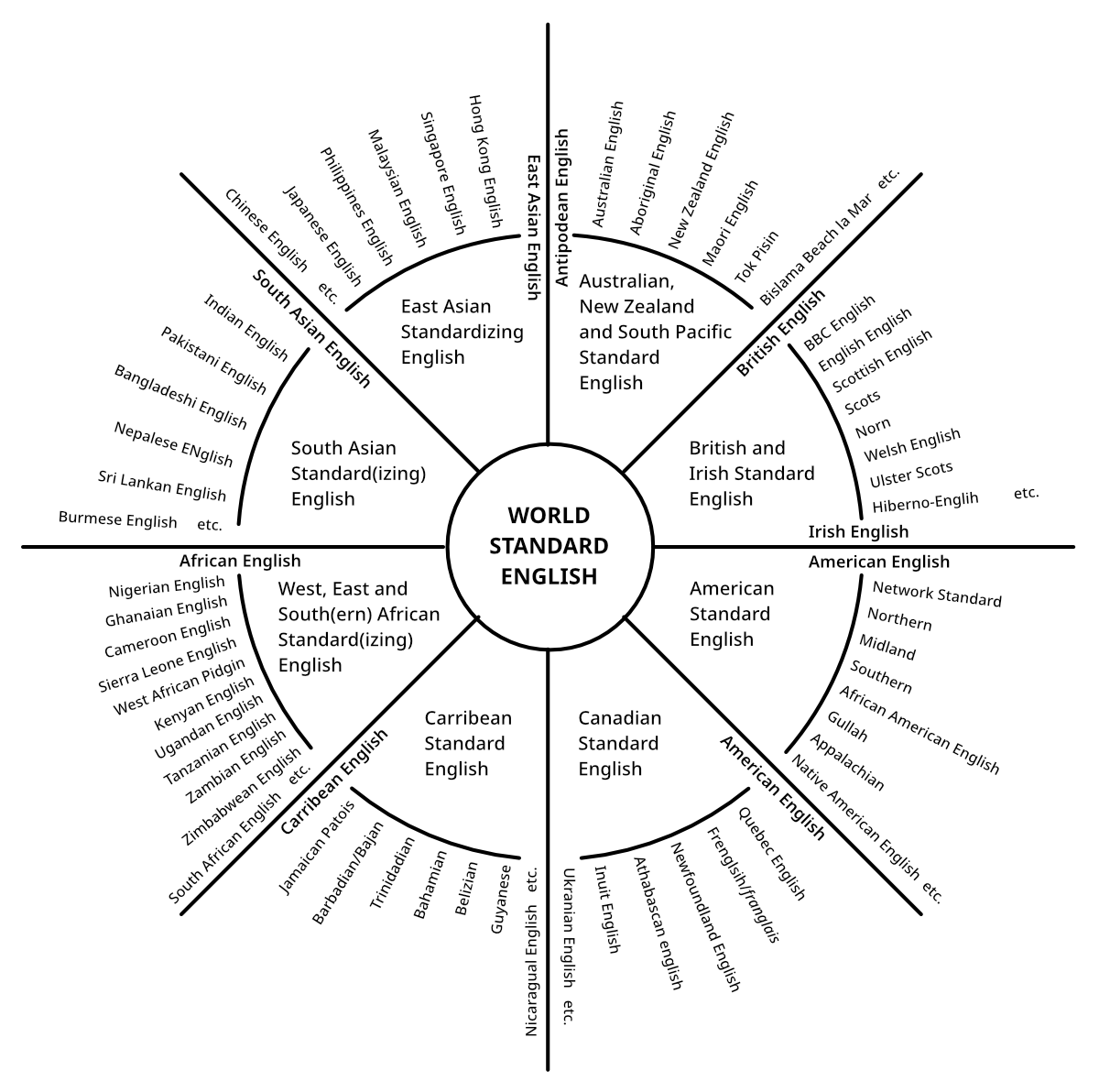
A circle labelled WORLD STANDARD ENGLISH, surrounded by eight wedge-shaped sections representing different regional standards or standardizing varieties of English: British and Irish Standard English, American Standard English, Canadian Standard English, Caribbean Standard English, West, East and South(ern) African Standard(izing) English, South Asian Standard(izing) English, East Asian Standardizing English, and Australian, New Zealand and South Pacific Standard English. At the outer side of each wedge, specific regional dialects and sub-varieties are arranged radiating outwards.
McArthur’s model is very different from Kachru’s. Although it makes some of the same distinctions (for example, referring to some varieties as “Standard” and others as “Standardizing”, and questioning himself, whether for example East Asian Englishes are, in fact standardizing at all), the model does not accord a special place to any of the varieties. Instead, it is supposed to show how many different individual varieties of English exist, which may contribute to regional standards, and how these standards, in turn, contribute to a global standard that, according to McArthur, consists of the lexical and grammatical core of written English when used as a lingua franca.
Subsection
CC-BY-NC-SA 4.0. Written by Anatol Stefanowitsch
